The IEA’s Global Critical Minerals Outlook 2026 narrowed the projected 2035 copper supply gap, from around 30% in last year’s report to about 25% this year. After a decade in which that gap only widened, this is real progress from real projects moving forward. For the copper that electrification, data centers, and modern life demand, every point is millions of tonnes and billions of dollars.
Almost none of it is new
The narrowing is driven almost entirely by expansions and life extensions of mines that already exist: the Kisanfu and Lumwana expansions in Africa, the Highland Valley life extension in Canada, the Antamina extension in Peru. These are good projects.
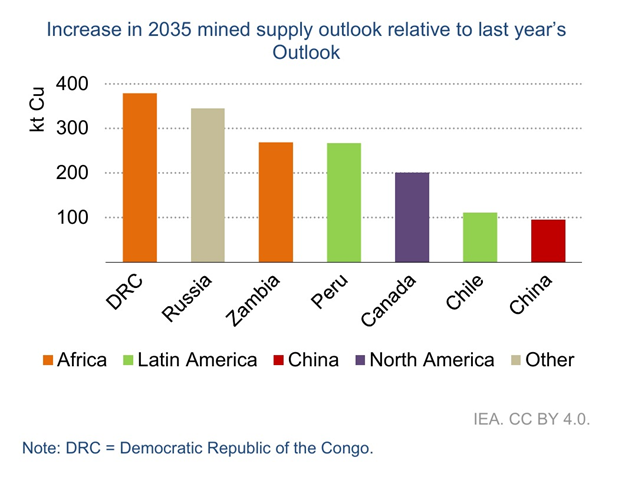
Closing the supply gap this way is like drawing down savings instead of raising income. Savings are finite, and the genuinely new supply that would refill the account is not arriving. Resolution Copper in Arizona, one of the largest undeveloped copper deposits in North America, is so tangled in litigation that the IEA left it out of its forecast entirely, in both the base and the high case. The supply gap closes only if we resolve what is blocking these deposits, not by forcing them to production.
The good news is real. It is also the sound of an industry spending its savings.
The step no one sees is the one that is failing
What makes the progress fragile is a step almost no one outside the industry pictures.
Before copper becomes metal, its ore is concentrated by flotation, then smelted; most sulfur is stripped at the concentration stage, the rest driven off in the furnace. The smelter is a choke point. Nearly every tonne of the world’s primary copper passes through one, and that step is now breaking down financially and physically at once.
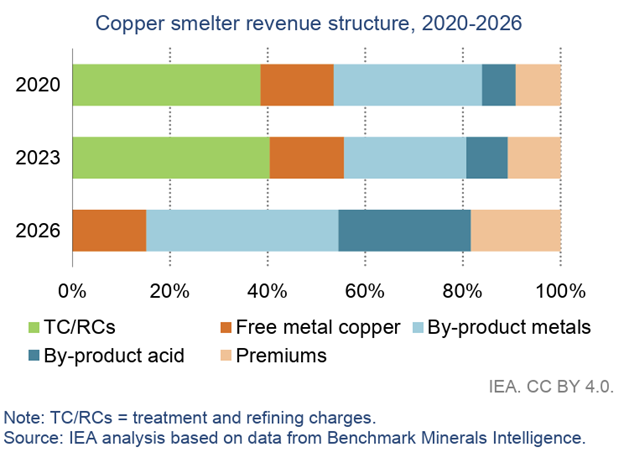
Financially, the benchmark fee to process a tonne of concentrate settled at zero dollars in early 2026, the lowest ever agreed, according to the IEA, and spot fees have been negative since 2024. Since 2005, China has built more than 90% of the world’s new copper smelting capacity, lifting its share from around 15% to roughly half. That build-out has so outrun available copper that the fee to process a tonne has been competed to nothing.
Smelters outside China now run below 70% of capacity while China’s run near 85%. Many stay open only by selling the byproducts, the gold, silver, and sulfuric acid, that ride along with the copper. If the prices of these byproducts drop, smelters, especially those outside of China, will be at risk of closing.
Physically, the furnaces go dark. Some outages are ordinary aging, especially for the many 40+ year-old smelters outside of China, as equipment wears out. But when the fee is zero and nothing suggests it will recover soon, a smelter has little reason to run into a loss.
Pulling maintenance forward, taking the furnace down for an extended overhaul, becomes a rational way to wait out a cycle that offers no upside. And while the furnace is down, the copper has nowhere to go.
Zambia just showed what that costs
It happened this year, in one of the countries the IEA credits for narrowing the gap.
Zambia charges a 10% duty on exports of raw copper concentrate. Its purpose is the ambition every copper-producing nation holds: process the concentrate at home and capture the value of the finished metal instead of shipping it away as rock. This June, for the second time since August 2025, Zambia suspended that duty on more than 270,000 tonnes of concentrate, because its own smelters were down for extended maintenance and could not process the copper, as Reuters and Mining.com reported. A nation that wrote its ambition into law had to ship its copper out unfinished, handing the value to someone else’s smelter, because a single step that captures it had failed.
That is the whole problem in one event. Lean on it and it gives way, and the copper’s value leaves on a ship.
What protecting the good news requires
If the weak link is a single, centralized, financially strained smelter, the fix is not a bigger smelter somewhere else. It is a way to process copper that a producing country can run at its own mine, without a furnace in the chain. Recovering the copper through new leaching methods, ideally converting the sulfur to a saleable product as smelters do, can bring projects to market faster. There is no smelter to build, to staff, or to take down for repairs. A small number of companies, including my own, Still Bright, are working to prove that route at commercial scale.
None of this diminishes the progress in that IEA report. But supply built on drawn-down savings, running through a step that goes dark whenever the math turns, is not supply the world can count on, nor a future its owners can build on. The way to protect the good news is to stop depending on the step that keeps breaking.
Ranulfo (Randy) Allen, PhD, MBA, is the co-founder and CEO of Still Bright, a seed-stage deep-tech company leveraging proprietary electrochemical reductive leaching of rougher concentrates to recover copper.