HIGHLIGHTS
- Cobalt royalties could raise costs
- Indonesia produced 18.3% of world’s cobalt in 2025
- Need for cobalt supply source diversification: experts
Indonesia’s plan to redefine cobalt as an independent mineral and impose royalties on it could raise costs for miners and impede the nation’s progress as a major producer of the battery mineral, industry participants told Platts, part of S&P Global Energy.
The Indonesian Nickel Miners Association has submitted a request to the government, seeking to maintain cobalt’s status as a byproduct of nickel production, Meidy Katrin Lengkey, the association’s secretary general, said.
The group submitted the request as the government evaluates the potential reclassification of cobalt in early 2026, as part of planned changes to the nickel benchmark price formula. Indonesia previously proposed a 1.5% royalty on cobalt metal and a 2% royalty on cobalt as a byproduct of nickel matte production.
Increasing cobalt output from Indonesia, the world’s leading nickel producer, has eased some pressure on the tight cobalt market, led by the Democratic Republic of Congo. However, Indonesia’s proposed actions might increase costs for integrated nickel-cobalt producers, potentially making new downstream investments less attractive to support the country’s cobalt expansion, experts said.
“A 1.5%–2.0% rise in costs is material and could discourage investment in new processing facilities,” Joel Crane, commercial manager at Australia-based Cobalt Blue Holdings Ltd., said.
Indonesia’s Ministry of Energy and Mineral Resources did not respond to Platts’ requests for comments on the matter.
Indonesia’s cobalt rise
Experts believe that the royalty plan could hurt Indonesia’s potential as a major alternative source of cobalt outside Congo. Indonesia became a significant cobalt supplier due to the expansion of high-pressure acid leaching facilities, which produce not only nickel as the main product but also cobalt as a byproduct.
Indonesia produced 38,324 metric tons of cobalt, accounting for 18.3% of global output in 2025, a significant increase from just 926 metric tons, or 0.69% of the world supply, in 2020, according to S&P Global Market Intelligence data. The country’s share of the world’s cobalt is expected to grow to 37.2% in 2030, according to Market Intelligence.
Experts said that the expected increase in Indonesian cobalt supply might be affected by government policies. In addition to taxing cobalt with royalties, Indonesia plans to reduce nickel ore production, which could limit the supply of cobalt linked to nickel production.
“These measures increase cost pressure and regulatory friction at the margin, which supports tighter global supply dynamics,” Duncan Blount, chairman and CEO of Chilean Cobalt Corp., said.
The African nation accounted for 73% of the total cobalt mine supply in 2025, according to Market Intelligence data. However, supply tightened as Congo banned exports of cobalt hydroxide in February 2025 and later introduced export quotas.
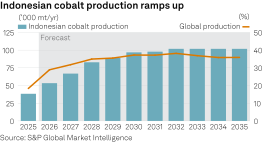
The shift in Indonesia’s cobalt strategy may also affect the broader cobalt market, according to industry players.
“The move could contribute to firmer medium-term pricing by reinforcing cost floors, particularly at a time when cobalt supply remains vulnerable to policy interventions in the DRC and ongoing market concentration risks,” Mitchell Smith, metals and mining partner at Vancouver-based Moneta Securities, said.
The plan may also promote “greater market transparency on Indonesian cobalt supply, which could improve market efficiency and reduce price and supply volatility in the long run,” a spokesperson for Brazilian Nickel Plc told Platts.
Diversification essential
So far, the direct market effect of proposed royalties on Indonesian cobalt has been minimal due to the relatively low royalty rates and the low cobalt content in Indonesian nickel laterite ores, according to S&P Global CERA analysts Jomar Camposano and Alice Yu.
PT Vale Indonesia Tbk, which produces cobalt as a byproduct of its nickel matte production, told Platts that it does not expect the proposed cobalt royalties to significantly impact its operations.
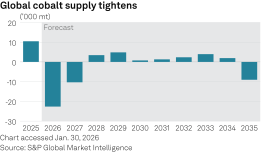
Supply uncertainty in Indonesia and Congo highlights the industry’s need to develop alternative cobalt sources, especially as supplies are expected to remain tight in the coming years, experts said.
“For producers and traders, diversification of supply sources and careful assessment of policy stability will be all the more important,” Blount said.
Platts assessed cobalt hydroxide with 30% cobalt content at $25.80/lb CIF China on Feb. 6, up 10 cents/lb day over day and week over week.
Platts assessed battery-grade cobalt sulfate with 20.5% cobalt content at Yuan 94,300/mt DDP China on Feb. 6, unchanged day over day and up Yuan 200/mt week over week.